
D Kurd Handpan Scale: Notes, Chords and Sound
D Kurd is the most popular handpan scale in the world. A D Kurd 9 handpan has a low D3 ding surrounded by eight notes: A3, B♭3, C4, D4, E4, F4, G4 and A4. That is a complete D minor scale, which is why it sounds warm and emotional and why so many players choose it as their first handpan. You can play one right here.
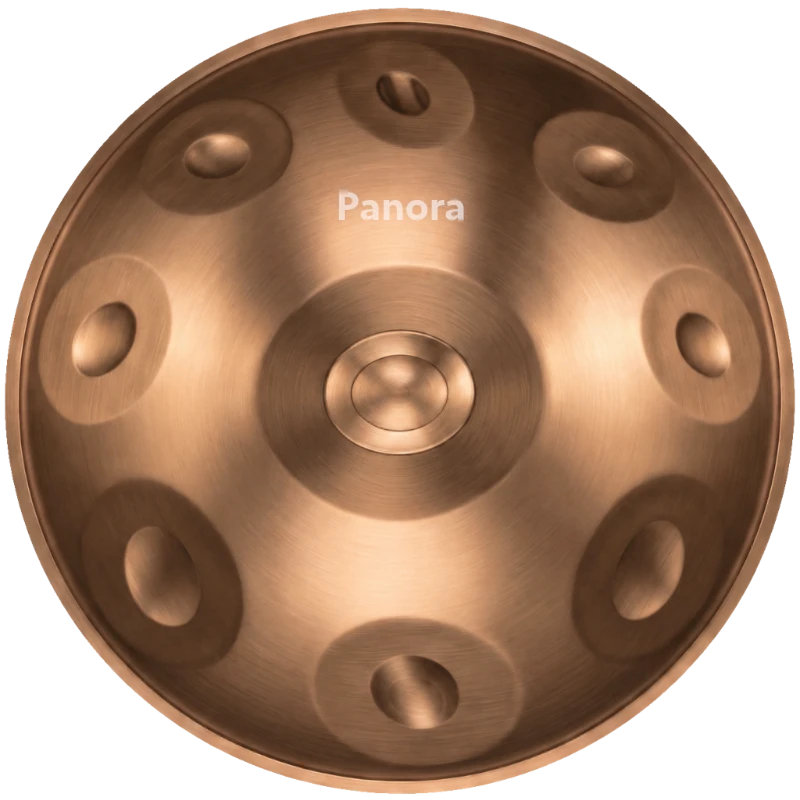
Tap or click any note to play D Kurd 9. Headphones recommended.
D Kurd notes and layout
On a handpan the notes do not run around the circle in order. They zig-zag from left to right, low to high, so that neighbouring notes in the scale sit on opposite sides and your hands can alternate. On the handpan above, the lowest tone field (A3) is at the bottom and the notes climb in a zig-zag up to A4 at the top.
| Position | Note | Role in D minor |
|---|---|---|
| Ding (centre) | D3 | Root, the home note |
| 1 | A3 | Fifth, below the root's octave |
| 2 | B♭3 | Minor sixth, the dark colour |
| 3 | C4 | Minor seventh |
| 4 | D4 | Octave of the ding |
| 5 | E4 | Second (ninth) |
| 6 | F4 | Minor third, the sad colour |
| 7 | G4 | Fourth |
| 8 | A4 | Fifth |
Count the note names and you will find all seven: D, E, F, G, A, B♭ and C. Many handpan scales leave notes out to sound more exotic. D Kurd keeps the whole minor scale, which makes it the most versatile of the classic handpan scales.
What does D Kurd sound like?
Melancholic but warm. The minor third (F) gives it a gentle sadness, and the minor sixth (B♭) adds depth and a slightly cinematic feel. Because nothing in the scale is unusual to Western ears, it never sounds strange: it sounds like a film soundtrack, a lullaby or a quiet evening.
That is also why D Kurd is a favourite for meditation and sound healing: it is emotional enough to be moving, and familiar enough to let you relax instead of listening closely.
Why is it called Kurd?
Start on the lowest tone field, A3, and play upwards: A, B♭, C, D, E, F, G. That pattern, a minor scale with a half step right above the starting note, is the Kurd maqam of Middle Eastern music (Western theory calls it the Phrygian mode). Handpan makers borrowed the name. From the ding, the very same notes form D natural minor, which is why D Kurd is often simply called a D minor handpan.
Chords you can play on D Kurd
With all seven notes available, D Kurd plays six full chords. Hit the three notes together or one after another as an arpeggio:
| Chord | Notes | Positions |
|---|---|---|
| D minor | D4, F4, A4 | 4, 6, 8 |
| F major | F4, A4, C4 | 6, 8, 3 |
| G minor | G4, B♭3, D4 | 7, 2, 4 |
| A minor | A3, C4, E4 | 1, 3, 5 |
| B♭ major | B♭3, D4, F4 | 2, 4, 6 |
| C major | C4, E4, G4 | 3, 5, 7 |
Dm → B♭ → C → Dm is one of the most used chord progressions in pop and film music, and it sits perfectly on a D Kurd. Notice the trick: chords are always every other position (1-3-5, 2-4-6, 3-5-7), because of the zig-zag layout.
Four beginner patterns to try
Use the handpan at the top of this page, or Panora on your phone. Numbers are positions from the table above.
- Heartbeat: Ding, Ding, 1, 4. Repeat slowly. This is the pulse most handpan grooves are built on.
- Open minor: Ding, 4, 6, 8, 6, 4. A D minor arpeggio that rises and falls like a breath.
- The Kurd colour: 1, 2, 1, Ding. The half step between A3 and B♭3 is the sound that gives Kurd its name.
- Chord walk: 4-6-8, then 2-4-6, then 3-5-7, then back to 4-6-8. That is Dm, B♭, C, Dm. Add the ding between chords and you have a song.
D Kurd 9, 10 and bigger versions
The number after the name is how many notes the handpan has, counting the ding. D Kurd 9 is the classic layout described here. Larger versions add notes on top, such as C5 on a D Kurd 10, or extra bass notes on the bottom shell, depending on the maker. The same pattern also exists in other keys, such as C♯ Kurd or E Kurd, which sound a little lower or higher but feel the same.
D Kurd vs other popular handpan scales
- D Kurd has all seven notes of D minor: emotional, warm and the most versatile.
- Celtic minor (Amara) leaves out the B♭, which removes the darkest colour. It sounds more open and floating.
- Hijaz uses an augmented second for a strongly Middle Eastern sound: beautiful, but more exotic and less flexible for Western melodies.
The best way to choose is to listen. Panora includes 50 handpan scales, so you can play D Kurd, Celtic minor, Hijaz and many more side by side before you spend money on a steel instrument.
Is D Kurd a good first handpan?
For most people, yes. It is the scale you hear most in handpan videos, it plays chords and real melodies, and it is easy to find from almost every maker, which also makes it easier to resell. If you are drawn to brighter, happier music, try a major scale too, but if you love the classic handpan sound, D Kurd is a safe choice.
Frequently asked questions
What notes are in the D Kurd handpan scale?
D3 (ding), A3, B♭3, C4, D4, E4, F4, G4 and A4 on a D Kurd 9.
What is the difference between D Kurd and D minor?
D Kurd is D natural minor on a handpan, so the two names are often used for the same layout. Some makers use "D minor" for a slightly different set of notes, so always compare the note list.
Can I play D Kurd online?
Yes, with the handpan at the top of this page or on our home page. Both are free and work in any browser.
Which app has a D Kurd handpan?
Panora has D Kurd 9 along with 49 other scales, plus loop recording and a sequencer to compose with it. See our comparison of the best virtual handpan apps for other options.